An armoured vehicle may look similar to a standard vehicle from the outside, but beneath its familiar exterior lies a carefully engineered protection system. Ballistic steel, composite armour, bullet-resistant glass, reinforced doors, protected pillars and upgraded mobility components must all work together without affecting the vehicle’s essential functionality.
Before an armoured vehicle reaches the customer, it must undergo a series of inspections and evaluations to confirm that its protection, handling and everyday usability meet the intended requirements.
The armoured vehicle testing process is therefore not limited to firing bullets at a completed vehicle. It begins with material selection and continues through engineering checks, ballistic validation, quality inspection and road-performance testing.
At JCBL Armouring Solutions, materials and vehicle systems are tested through structured quality processes, supported where required by independent testing laboratories. The objective is simple: every vehicle must deliver dependable protection while remaining practical, stable and comfortable on the road.
Protective Materials: Testing the First Line of Defence
The effectiveness of an armoured vehicle begins with the materials used to protect it. Armour plates, composites and ballistic glass are therefore evaluated according to the required protection level before installation.
Key areas of ballistic testing for armoured vehicles include:
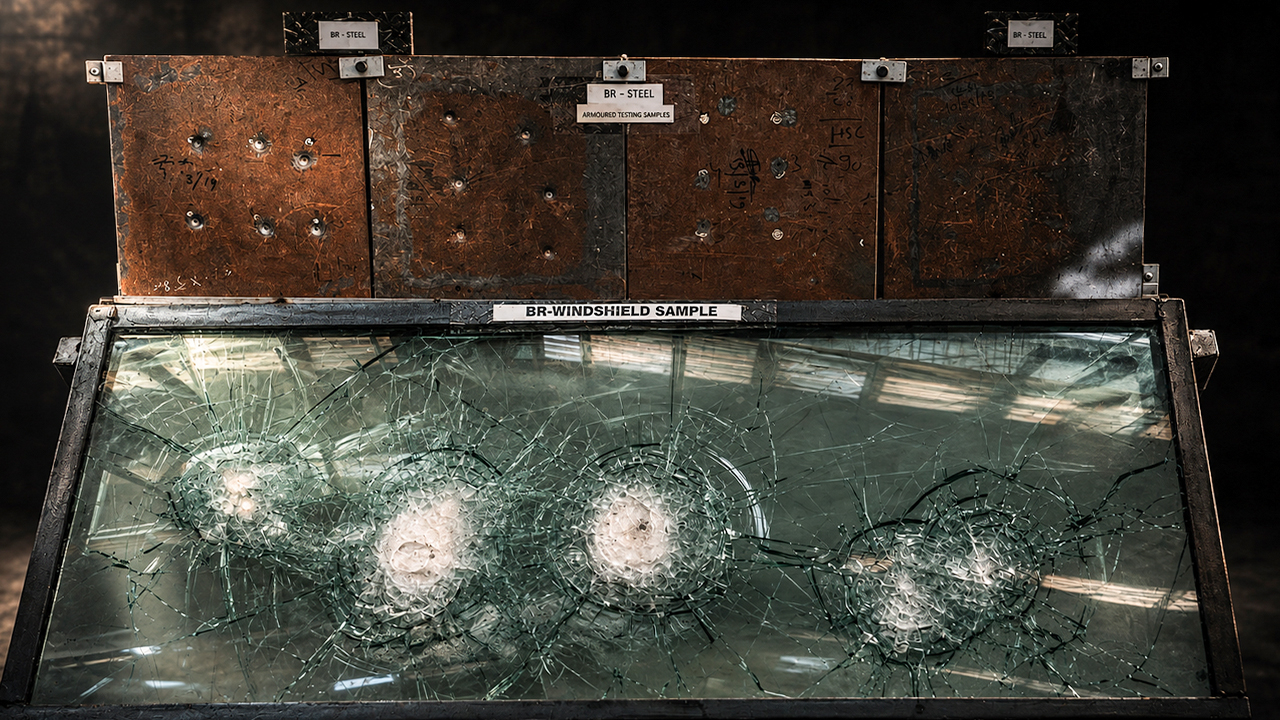
- Armour Material Testing: Representative samples are tested against specified ammunition under controlled conditions.
- Impact Assessment: Projectile type, impact velocity, firing distance, number of shots and shot placement are considered according to the applicable testing protocol.
- Ballistic Glass Testing: Multi-layered bullet-resistant glass is evaluated for penetration, impact absorption and the possibility of hazardous fragments entering the passenger compartment.
- Protection Standards: Recognised protocols such as VPAM provide testing and documentation guidelines for protective materials and bullet-resistant vehicles.
- Application-Based Testing: The exact testing requirements depend on the desired protection level, vehicle application and customer specifications.
Beyond Ballistics: Examining the Armoured Structure
Testing does not stop with individual armour materials. Once installed, the complete protective structure must also be inspected to ensure that the different elements work together effectively.
Important checks include:
- Armour Integration: Engineers inspect overlaps and protected areas around doors, windows, pillars, the roof and other vulnerable sections.
- Door Reinforcement: Hinges, mounting points and supporting structures are checked to ensure they can handle the additional weight of armoured doors.
- Ballistic Glazing: Glass installation and its integration with surrounding armour are carefully examined.
- Safety-Critical Components: Emergency-access provisions, protected electrical components and other essential systems are inspected.
- Blast Protection: Where required, separate evaluations may be carried out according to specialised blast-resistance testing procedures.
Road Testing: Ensuring Vehicle Performance
Armouring increases vehicle weight, which can affect acceleration, braking, steering, suspension and overall stability. Road testing is therefore an important part of the bulletproof car testing procedure.
The evaluation typically covers:
- Handling & Stability: The vehicle is assessed for changes in steering, balance, alignment and overall driving behaviour.
- Braking Performance: Braking response is checked considering the additional weight of the armour.
- Suspension Performance: Engineers observe how the suspension performs under the increased load.
- Run-Flat Systems: Run-flat solutions are evaluated under practical on-road and off-road operating conditions.
- Functional Systems: Air-conditioning, power windows, locking systems, lighting, warning indicators and onboard electronics may also be inspected.
Final Approval: Confidence Built Through Inspection
Before delivery, the completed vehicle undergoes a final inspection to ensure that its protective, mechanical and functional systems meet the required specifications.
Final checks may include:
- Protective Construction: Verification of armour integration and specified protective components.
- Doors & Glass: Inspection of door alignment, ballistic glazing, seals and fastening points.
- Mechanical Systems: Suspension behaviour and other vehicle systems are reviewed after conversion.
- Interior & Electrical Systems: Interior panels, electronics and functional equipment are checked for correct operation.
- Overall Finish: The vehicle is inspected to ensure that protection is integrated while maintaining its refinement, comfort and premium appearance.
Final Thoughts
Armoured vehicle testing goes beyond ballistic resistance. It brings together material validation, structural inspection and road-performance checks to ensure protection, stability and everyday usability work as one complete system.
At JCBL Armouring Solutions, every stage of testing supports one objective: delivering an armoured vehicle that is carefully evaluated, dependable and ready for the road.
Disclaimer
The information provided above is indicative in nature. Legal procedures, documentation, and regulatory requirements for owning or armouring a vehicle may differ across states and are subject to changes in government policies, laws, and applicable regulations.